Cabrini University History
In 1957, the Missionary Sisters of the Sacred Heart of Jesus (MSC), the religious order founded by Saint Frances Xavier Cabrini, secured the charter for Cabrini College.
Led by the College’s first president, Sister Ursula Infante, MSC, Cabrini is the first and only institution of higher learning founded by the order.
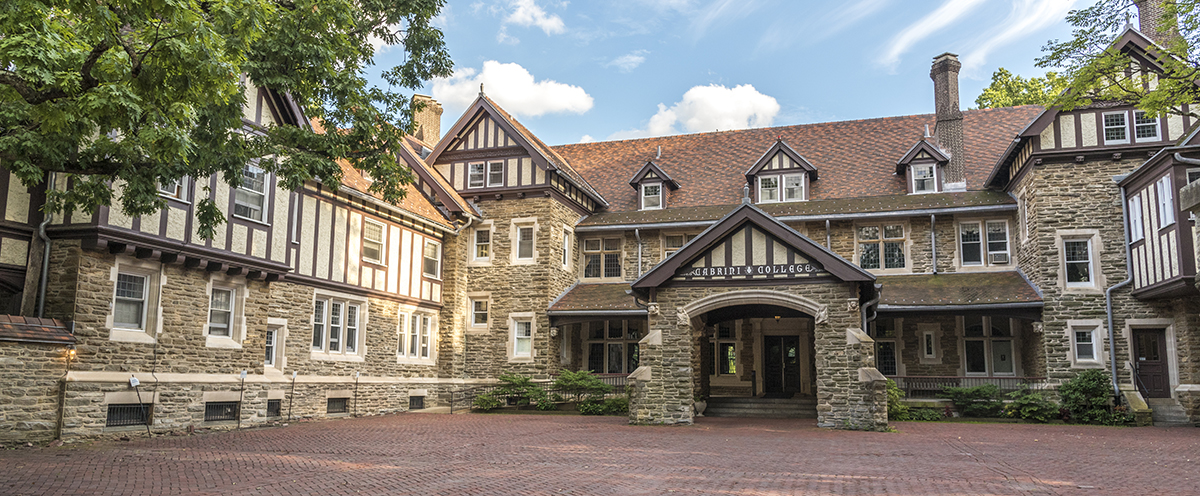
In the fall of that year, 43 women arrived on campus as the first students of Cabrini College. With the Woodcrest Estate Mansion serving as centerpiece of the campus, the College made plans to expand.
In 1970, the first male students enrolled at Cabrini, and a year later the Evening Division opened, attracting non-traditional students to campus.
During following decades, enrollment reached 1,000 students for the first time, and Cabrini counted more than 10,000 alumni.
The College helped form the Pennsylvania Athletic Conference (now the Colonial States Athletic Conference), and offered majors and programs that reflect 21st Century education, including biotechnology, an online certificate program in web system design, and a master of science in organizational leadership.
Throughout its history, Cabrini has been at the forefront of social justice learning among colleges and universities. Nationally, the College—now University—is among the first in higher education to implement community service into its curriculum, and is the first in Pennsylvania to require community service of all undergraduates.
In 2014, the College welcomed its first male president, Donald B. Taylor, PhD, who announced that Cabrini will recruit more Hispanic and international students, while moving forward with plans to build the Athletic and Recreation Pavilion expansion of the Dixon Center.
And in 2016, the Pennsylvania Department of Education (PDE) approved Cabrini’s application to become Cabrini University.
Cabrini Timeline
1957
- Cabrini College receives its charter from the Commonwealth of Pennsylvania.
- Founding president, Sister Ursula Infante, MSC, welcomes the first 43 students to campus.
1960
- Bishop Furey dedicates Sacred Heart Hall, now Founder’s Hall.
- First physics laboratory is created.
1961
- Cabrini holds first commencement; 35 students graduate.
- Bruckmann Memorial Chapel is completed.
1965
- Cabrini accredited by the Middle States Association of Colleges and Schools.
- Holy Spirit Library is completed.
1967
- Counsel Hall, now the Rooymans Activity Center, is completed.
- Women’s basketball and field hockey are established as the first athletic teams.
1968
- Sister Gervase Lapadula, MSC, is named second president.
- First residence hall is built.
1969
- Sister Regina Casey, MSC, becomes third president.
- Woodcrest Hall dedicated on November 13, Mother Cabrini Feast Day.
1970
- The Board of Trustees amends the College charter to accept male students.
1971
- The evening division opens.
1972
- Sister Mary Louise Sullivan, MSC, PhD, named fourth president.
1973
- Joseph Romano, PhD, receives first faculty award.
1974
- Joseph Silvestrini ’75 becomes first male president of Student Government Association.
- First early childhood center, now The Children’s School, is established.
1975
- Women’s volleyball team and men’s basketball team are formed.
1977
- The Black Student Union, International Club, and Athletic Association are formed.
1979
- Men’s soccer team is formed.
1980
- Maguire, Dixon, and Infante Houses are built, and the Widener Trust funds the building of a campus center.
1981 (25th Anniversary)
- McManus, Casey, Lanshe, and Sullivan Houses are built.
- Pew Charitable Trust provides funds for a communications lab in the Widener Campus Center.
1982
- Sister Eileen Currie, MSC, is named Cabrini’s fifth president.
- Widener Campus Center opens.
1984
- Xavier Hall is built.
1989
- Renovations to Grace Hall are completed.
1992
- Antoinette Iadarola, PhD, becomes the College’s sixth and first lay president.
- Cabrini helps form the Pennsylvania Athletic Conference (PAC).
- The College’s first strategic plan is developed.
1993
- The Southeastern Pennsylvania Consortium for Higher Education is established. President Iadarola plays a major role in bringing together SEPCHE’s eight member schools to collaboratively address the challenges of higher education.
1997
- Mother Ursula, MSC, founding president, celebrates her 100th birthday.
- Cabrini named to the John Templeton Foundation's Honor Roll for Character-Building Colleges.
- First Strategic Plan complete, second Strategic Plan developed.
1998
- Dixon Sports Center and Cabrini Apartment Complex are built.
2000
- The Hamilton Family Foundation Wing opens in Founder’s Hall.
- Cabrini College student newspaper, The Loquitur, named to the top class of college and university newspapers by the Associated Collegiate Press.
2001
- East Residence Hall is built.
- Cabrini athletic teams secure six PAC championships.
2002
- Wolfington Center is dedicated.
- President Iadarola celebrates her 10th Anniversary.
2003
- Cabrini breaks ground for $18.5 million Center for Science, Education, and Technology.
2006
- West Residence Hall is built.
- Cabrini’s first artificial turf field, the Edith Robb Dixon Field, is completed with lighting and seating for 700.
2007
- Cabrini celebrates its 50th Anniversary.
2008
- Marie Angelella George, Ph.D., becomes the College’s seventh president.
2009
- Cabrini launches its groundbreaking core curriculum, Justice Matters.
2010
- The College develops a partnership with Cabrini Ministries in Swaziland, with faculty providing teacher development to benefit the orphaned and vulnerable children that Cabrini Ministries serves.
2012
- The College’s men’s and women’s lacrosse teams both end the season with a Colonial States Athletic Conference title, and the men’s basketball team appears in the NCAA Division III finals.
2013
- Deb Takes transitions from Chair of the Board of Trustees to Interim President while Cabrini conducts a national search for the College’s eighth president.
- Cabrini secures doctoral degree partnerships for programs with Temple University, Thomas Jefferson University, and Widener University.
- The Nerney Leadership Institute at Cabrini College is founded.
- Cabrini College is one of only 17 colleges and universities nationwide to be recognized as a Fair Trade College, as determined by Fair Trade Colleges and Universities in partnership with Fair Trade USA.
2014
- Donald B. Taylor, PhD, becomes the College’s eighth president and the first male president.
2015
- Cabrini launches doctoral programs in Educational Leadership and Organizational Development, as well as a Master of Arts in Religious and Pastoral Studies and a Master of Science in Biological Sciences
- Cabrini named a Military Friendly® School
- Men’s baseball and women’s rowing added as intercollegiate athletics teams
2016
- Cabrini College becomes Cabrini University.
- Women’s rowing, Cabrini’s 18th intercollegiate sport, begins competition.
- The Redevelopment Assistance Capital Program (RACP) awards the University $1 million in state funds to support a pedestrian-centric campus and advance sustainable growth on campus.
- The Athletics & Recreation Pavilion at the Dixon Center opens.
- The National Science Foundation (NSF) awards Cabrini a $649,773 grant to support the Science Scholars for Social Justice (SSSJ) Program, which engages students, especially female and minority students, in STEM learning through a social justice framework.
2017
- The Pennsylvania Department of Education’s Bureau of School Leadership and Teacher Quality (BSLTQ) awards $1.27 million to Cabrini and partner institutions LaSalle University and Eastern University for their Early Learning Principal Instructional Coaching Program.
- The University launches new academic centers: The Center for Urban Education, Equity, and Improvement; the Cabrini Center on Immigration; and the Center for Children of Trauma and Domestic Violence Education.
- Thomas P. Nerney Pavilion is officially dedicated.
2018
- Cabrini is one of seven Division III institutions to form the new Atlantic East Conference (AEC).
- Inaugural Cav-a-Thon surpasses $10,000 goal and raises more than $19,000 for the Children’s Hospital of Philadelphia.
2019
- Cabrini launches The Cabriniana Collection, the largest digital archive of the writings and artifacts from Saint Frances Xavier Cabrini and the Missionary Sisters of the Sacred Heart of Jesus (MSCs).
- South Hall, a new student residence featuring group living space, and a parking structure are completed.
- Men’s lacrosse captures the Cavaliers’ first-ever NCAA DIII championship.
- Money Magazine names Cabrini among the Top 40 Most Transformative Colleges in the Nation.
- Cabrini is one of the first higher education institutions to partner with the School District of Philadelphia in Pennsylvania’s pilot program Aspiring to Educate (A2E), which aims to increase the diversity and number of teachers in the Commonwealth.
- James J. and Frances Maguire pledge $1 million toward Cabrini’s new Nursing program.
2020
- The spring semester adapts to a fully virtual learning modality with the outbreak of the COVID-19 pandemic in the United States in March 2020. In-person, hybrid, hyflex, and remote coursework are offered in fall 2020 and spring 2021.
- James J. and Frances Maguire make a $1 million gift to Cabrini’s new Nursing program, which includes operating and capital support as well as scholarship support through the creation of Maguire Nursing Scholars, an expansion of the existing Maguire Scholars program at Cabrini.
- Bachelor of Nursing program begins.
- The Pennsylvania Department of Education and the Pennsylvania Office of Child Development and Early Learning awards Cabrini a $158,493 Preschool Development Grant.
- The Public Health Management Corporation (PHMC), through its Early Childhood Education Professional Development Organization, grants Cabrini $195,408 to fund tuition for early childhood education professionals in the area.
2021
- The Accreditation Council for Business Schools and Programs (ACBSP) grants the Business Department full accreditation.
- The Nursing program debuts its new Clinical Simulation Center (CSC), a state-of-the-art facility and hands-on learning environment housed in the Antoinette Iadarola Center for Science, Education, and Technology.
- The National Endowment for the Humanities (NEH) awards the University a nearly $150,000 federal grant to fund the next phase in a Cabrini-led effort to digitize and exhibit artifacts telling the life story of Saint Frances Xavier Cabrini.
- As part of a comprehensive evaluation process and reinvention plan, Cabrini shifts from four Schools to three: Arts and Sciences, Business and Professional Studies, and Education. Programs in School of Humanities and Social Sciences shift to one of the other Schools.
- The University receives a second Fulbright grant for Bridges to Zambia, a month-long summer service-learning trip to Lusaka, Zambia.
- Cabrini begins an English as a Second Language (ESL) education program in partnership with Norristown Area School District (NASD), backed by a $2,510,538 National Professional Development Grant from the United States Department of Education.
- The Barbara and John Jordan Center for Children of Trauma and Domestic Violence Education receives a $298,352 grant from Department of Justice’s Office of Violence Against Women.
- The McLean Contributionship awards the Chemistry Department $45,000 to upgrade lab instrumentation.
2022
-
Statue of kickboxing world champion Fredia Gibbs (ʼ19) is dedicated at the reflection pond next to the Thomas P. Nerney Pavilion.
- The University expands its English as a Second Language (ESL) teacher education efforts to three new local school districts thanks to the second National Professional Development (NPD) grant of more than $2.9 million.
- President Donald Taylor announces his resignation. Helen Drinan, PresidentEmerita of Simmons University, becomes interim President.
- Cabrini adopts a three-year comprehensive plan that combines cost reductions with targeted efforts to increase strategic revenues.
2023
- Academic Affairs streamlines its operations with a new Dean and realignment under two Schools—Business, Education, and Professional Studies as well as Arts and Sciences—led by Associate Deans.
- Cabrini is named a Pennsylvania Hunger-Free Campus for the 2022‒23 year and awarded a $20,000 grant for work with the Cabrini Cupboard and Wolfington Center.
- The George I. Alden Trust awards Cabrini $117,000 for upgraded equipment in the Communication Department.
- As neighboring Catholic institutions connected by our aligned, faith-based missions, the boards of Villanova and Cabrini Universities have approved in principle an agreement that will preserve Cabrini’s history, mission, ministry, and legacy.